They Make You Write Your Poems - Artistic Practices Amid Automated Cognition
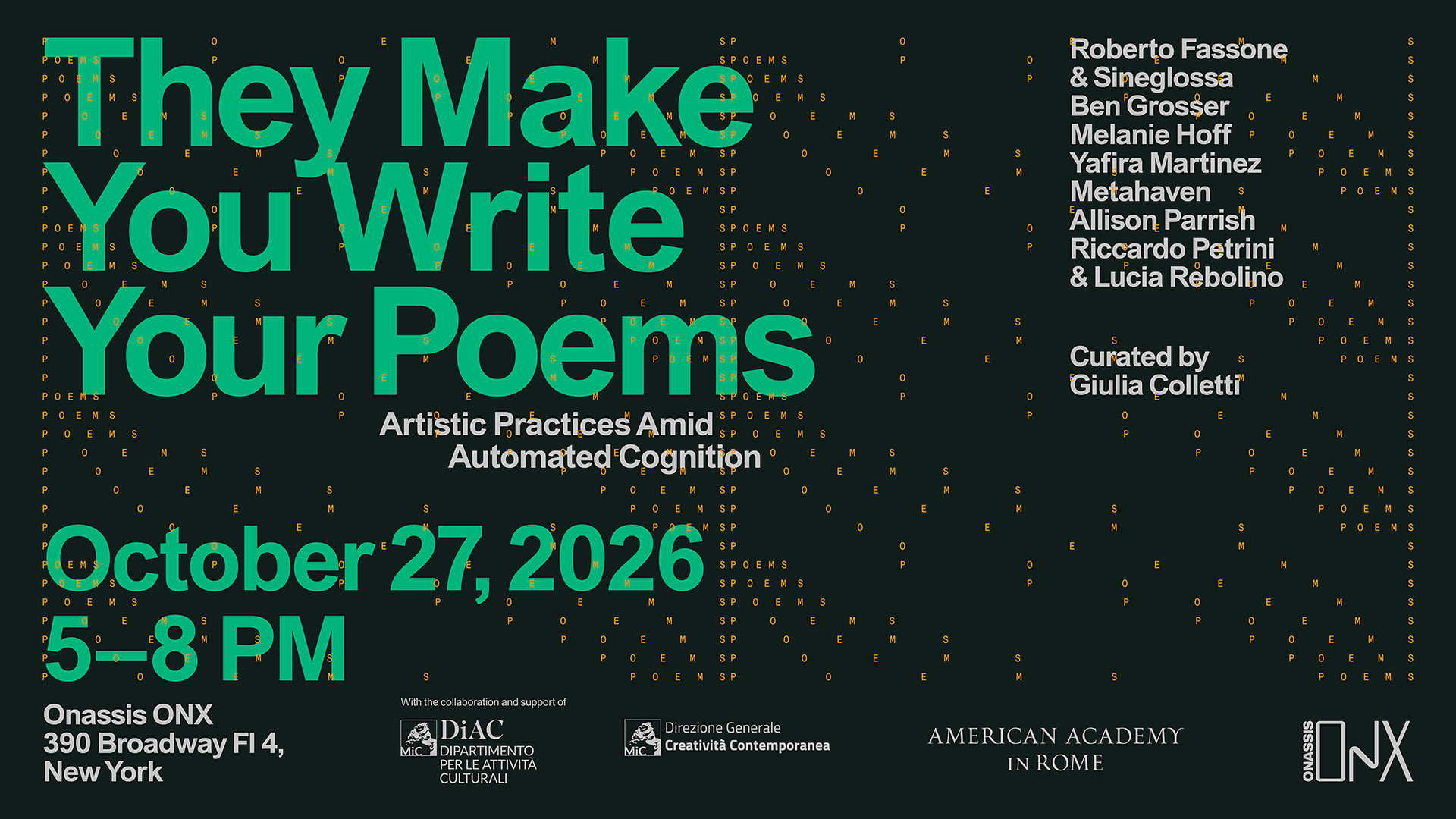
They Make You Write Your Poems brings together artists, poets, coders, and design engineers, who explore the relationship between somatic and machine cognition, embracing poetry as an “embodied technology” for resisting the settling of language in the expected.
This exhibition and public program reflects on the relationship between poetry and machine by also tracing back a lineage of processes encoded and re-encoded by artists. Before the advent of AI, computation encompassed any operation that followed rules and states, from patterns punched into cards to lines of verse assembled under the constraints poets set for themselves.
The artists featured in the exhibition engage with this lineage in different ways, taking their cue from transrational poetry, tide-predicting machines, and the textile roots of computing. Many of their works are encountered through the body, in a button pressed, a pad danced on, a device that wakes in the light or a sound filling the room.
They Make You Write Your Poems is curated by Giulia Colletti for the American Academy in Rome’s second Italian Fellowship for Curatorial Research, in collaboration with, and supported by, the Directorate-General for Contemporary Creativity of the Italian Ministry of Culture. It is hosted by Onassis ONX, the Onassis Foundation’s platform for art and advanced technologies.
Program
5:00 – 5:30 PM Doors open, exhibition on view
5:30 – 6:00 PM Panel discussion with Melanie Hoff, Yafira Martinez, Allison Parrish, Riccardo Petrini & Lucia Rebolino, moderated by Giulia Colletti
6:00 – 6:30 PM Reception
6:30 – 7:05 PM Screening of The Feeling Sonnets (Transitional Object) by Metahaven
Giulia Colletti is a curator whose work explores technological imaginaries and the automation of language, tracing how computational systems inherit the unresolved legacies of twentieth-century industrialization. She is the 2026 Italian Fellow for Curatorial Research at the American Academy in Rome. Her project Italian Brainrot: From Futurist Rupture to AI Nam-shubs examines how the collapse of language, once a deliberate avant-garde gesture, has become automated transgression, as algorithmic feeds select, amplify, and monetize semantic volatility. She is currently an AiR/ONX Mentor and Fellow at the Onassis Foundation. In 2025 she co-curated The Vast Automaton, the 5th Industrial Art Biennial, supported by the 13th Italian Council. In preparation for it, she was a Research Resident at the National Museum of Modern and Contemporary Art, Korea (MMCA) and the Inaugural Research Fellow at the National Taiwan Museum of Fine Arts (NTMoFA). From 2019 to 2025, she served as Curator of Public Programs and Digital at Castello di Rivoli Museo d’Arte Contemporanea, where she developed projects exploring digital trauma and energy cultures. She lectures in Contemporary Art at ABADIR Academy and her writing has appeared in CURA., Mousse, Flash Art, OnCurating, and e-flux.
Roberto Fassone is an artist working across performance, video, and conceptual installation. His practice often begins from playful premises that unfold into long-running bodies of work. His work has been shown at institutions including MAXXI and the Galleria Nazionale d’Arte Moderna in Rome, MAMbo in Bologna, Fondazione Sandretto Re Rebaudengo in Turin, the Istituto Italiano di Cultura in Paris, and Ars Electronica in Linz. He received the MAXXI BVLGARI PRIZE for Digital Art in 2023, the same year he was awarded the 64° Premio Termoli.
Ben Grosser is an artist who, through tactics such as software recomposition, interface reduction, and radical reimagination, exposes software’s hidden politics and proposes alternatives that restore user agency. His browser extensions, video supercuts, and networked installations have been exhibited at venues including Centre Pompidou, the Barbican Centre, ZKM, and the Louisiana Museum of Modern Art, with solo exhibitions at arebyte Gallery, Galerie Charlot, and Aksioma. His honors include First Prize in VIDA 16, a Net Art Grant from Rhizome, and an Artist’s Fellowship from the Illinois Arts Council. He is a Faculty Associate at Harvard’s Berkman Klein Center for Internet & Society.
Melanie Hoff is an artist, organizer, and technologist working across hacking, performance, and collective learning. Their practice examines systems of classification and power, creating artistic and organizational spaces where contradictions can be held and futures rehearsed. They teach art, technology, design, and social cybernetics at Harvard, NYU, and Yale. Their work has been exhibited at the New Museum, Queens Museum, Bronx Museum, and elsewhere. Hoff co-direct Hex House, an artist space they co-founded in Brooklyn, and co-founded Cybernetics Library. They formerly co-directed the School for Poetic Computation, where they can often be found teaching from the edges of their research and experimentation.
Yafira Martinez is a design engineer and creative technologist with a BS in Computer Science and a master’s degree from NYU’s Interactive Telecommunications Program (ITP) at the Tisch School of the Arts. Through her independent practice, Electrocute Lab, she explores open-source creative engineering, designing web tools, educational resources, and experimental interfaces that make complex technologies more approachable. Her practice spans front-end prototyping, physical computing, and hardware integration. A 2026 Open Hardware Summit Fellow, she presented her ITP thesis, The Soft Computer, in Berlin, and has presented work at a16z’s NY Tech Week, the Horological Society of New York, Temple University, and NYC Resistor.
Metahaven is an Amsterdam-based artist collective founded by Vinca Kruk and Daniel van der Velden, working across filmmaking, design, installation, and writing. Their practice pairs research with experimental aesthetics, often using poetry to connect art and science, or to question how language maps onto feeling. They recently co-authored Latent Spacecraft: Brains, GANs, Finnegans (2026) with Nina Beguš, Gašper Beguš, and Riccardo Petrini, reinterpreting James Joyce’s Finnegans Wake through the vector space of neural-network language models. Metahaven has held solo exhibitions at MoMA PS1, the Guggenheim Museum Bilbao, ICA London, and the Stedelijk Museum Amsterdam, and is artistic advisor at Rijksakademie and at Design Academy Eindhoven.
Allison Parrish is a computer programmer, poet, and game designer whose teaching and practice address the unusual phenomena that blossom when language and computers meet. She is an Associate Arts Professor at NYU’s Interactive Telecommunications Program. She was named “Best Maker of Poetry Bots” by the Village Voice in 2016, and her zine of computer-generated poems, “Compasses,” received an honorary mention in the 2021 Prix Ars Electronica. Allison is the co-creator of the board game Rewordable (Clarkson Potter, 2017), and her books, chapbooks and collaborations have been published by presses such as Counterpath, Instar, Aleator, and Nothing to Say. Her poetry has appeared in BOMB Magazine, Strange Horizons, Taper and Ninth Letter, among other publications. In 2024, she was the recipient of the Electronic Literature Organization’s “Maverick” award.
Riccardo Petrini is an artist and coder working with machine learning, custom scripts, and game spaces, rendering the internal, operational logics of computational models perceptible and traversable. Central to his practice is the ongoing development of new workflows, each released as open-source resources or libraries to enable reuse, modification, and extension by others. His work has been exhibited at the Museum of Contemporary Art Busan, the Arsenale, and Palazzo Diedo during the 19th Venice Architecture Biennale, and he recently co-authored Latent Spacecraft: Brains, GANs, Finnegans (2026) with Metahaven, Nina Beguš, and Gašper Beguš. He is currently a Research Scientist in the Machine Visual Culture: Artificial Intelligence and the History of Seeing group at the Bibliotheca Hertziana – Max Planck Institute for Art History.
Lucia Rebolino is an artist, architect, and computational designer whose work weaves science and art into digital aesthetics. She is a researcher with Forensic Architecture, focusing on environmental justice investigations, and an Adjunct Professor at Columbia University’s Graduate School of Architecture, Planning and Preservation. Her research on counter-models has appeared in e-flux and been exhibited at venues including the 19th Venice Architecture Biennale, the Museum of Contemporary Art Busan, and Nieuwe Instituut in Rotterdam, among others. She has also developed a research-based artistic practice exploring technology-driven screen performances, and has lectured at institutions including MoMA, Medialab Matadero, the Royal College of Art, and ETH Zurich.
Sineglossa is a research and cultural production studio that for more than fifteen years has developed transdisciplinary approaches at the intersection of art, technology, and society, moving between curation, education, and applied research to test new models of sustainable development. Its projects include the exhibition program The Next Real and Prompting the Real, on co-creation between artists and AI. Beyond exhibitions, Sineglossa runs training and consultancy programs for museums and cultural institutions on AI literacy and governance, and produces the podcast and online magazine Mangrovia. It collaborates with institutions such as Ars Electronica, Fondazione Sandretto Re Rebaudengo, MAST, and Museo Egizio, among others.
Tuesday, October 27, 2026
5:00 – 8:00 PM