
Dear Friends of the Academy,
I hope that all of you reading this had restorative end of year holidays and have entered the new year free from 2025’s encumbrances. This is the second State of the Academy letter that I have had the honor to present. As I noted last year, January is our month—the whole Janus-Janiculum-January thing—and so I’d like to begin by expressing my gratitude to the work of the staff and the support of the Trustees and our wider family of donors, without which nothing would be possible.
In 2024-25, the American Academy in Rome welcomed 31 Rome Prize winners, 5 Italian Fellows, 14 Residents, 19 Affiliated Fellows, and 108 Visiting Artists and Scholars. We served over 38,000 meals and 34,000 coffees. We welcomed more than 20,000 individuals to our events, concerts, exhibitions, Open Studios, and of course our Library and Archives. Eight Fellows and Residents won Guggenheim Fellowships (just for comparison, Yale posted five, Princeton six, Harvard three), two won MacArthurs (our first two- MacArthur year) and an Italian Fellow won the Premio Strega, Italy’s most prestigious literary award—alongside of the usual haul of awards, grants, top 100 listings.
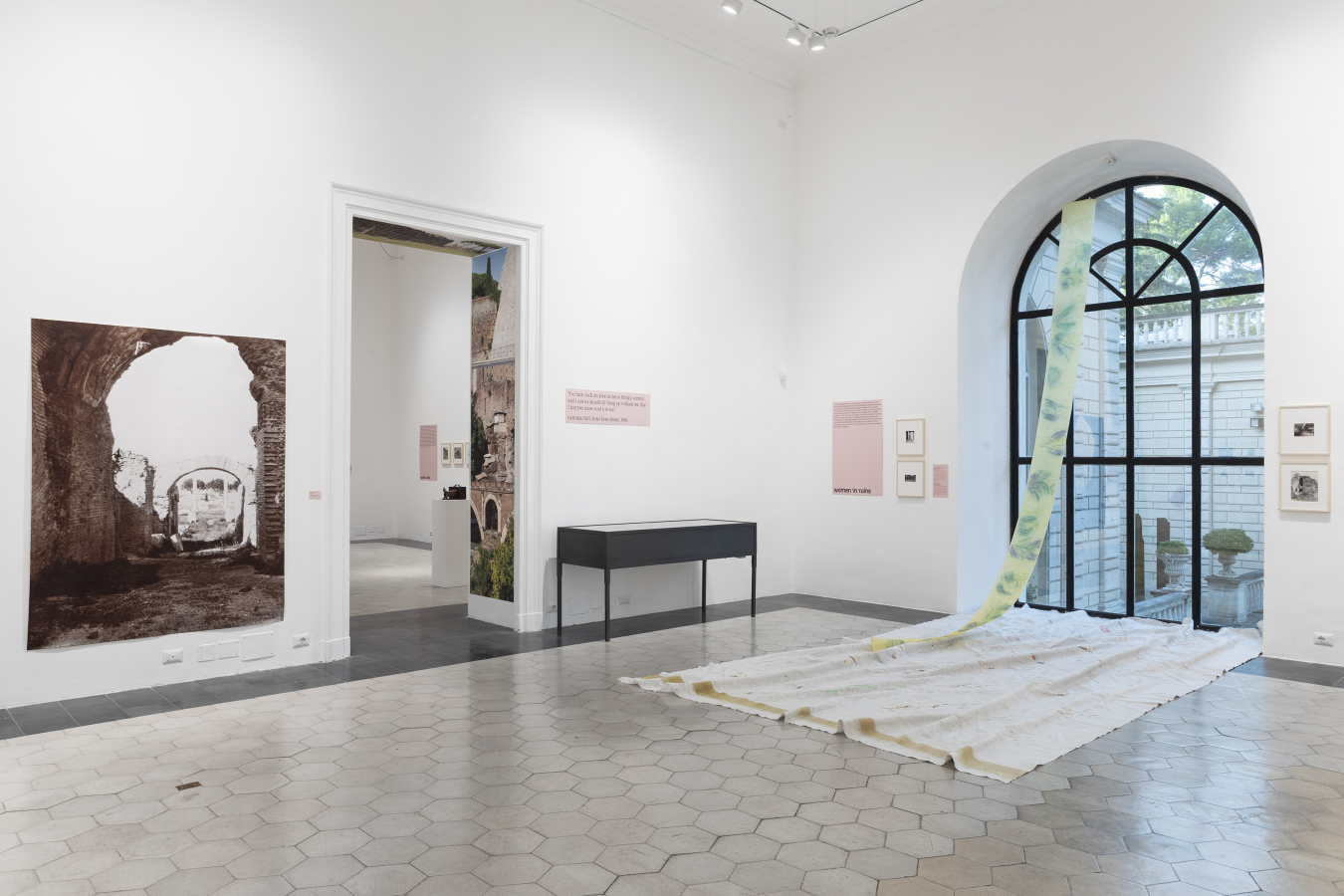
In Rome, this past fall, we closed our wonderful exhibition on women photographers of ruins (copies of the catalogue can be obtained here), Fellows and Residents went to Venice for events we organized at the Biennale Architettura 2025 at the US Pavilion and in the Arsenale, and one remained as a short-stay visitor at the University of Venice Ca’ Foscari New Institute Centre for Environmental Humanities (NICHE), continuing our relationship with them. We co-organized with Dartmouth and hosted an important conference on food and sustainability in December. In the coming months, we are hosting conferences on “Material Intelligence” bringing together artists, humanists, and scientists, a second on “Conservation and the Brain” with neuroscientists, conservators, and artists, and a third on the history of research, its current practice by artists, and its future in an AI-driven culture. Flight Paths, our spring exhibition, echoes many of these themes, showing how humans and birds have interacted in cities over time, shaping our imagination and our practices, but also offering diagnoses of our changing urban experience. In the fall, we are organizing a three-day festival of music and ideas around the very Academy topic of improvisation (think: “conversation”).
But the main thing occupying my time, and much of the Academy’s, in the second half of 2025 and continuing into the first months of 2026, is strategic planning. Not the kind that many of us have experienced, the top-down, pre-determined outcomes sort of planning. Instead, and setting the tone for every aspect of this process, we approached planning bi-directionally, led by both the Board and the staff, each from their own direction and their own perspective. A Board Strategic Planning Committee, chaired by Martin Brody, went into action in May 2025 charged with determining the main lines of direction. In July, a series of staff workshops in smaller and larger working groups cutting across the institution began a discussion of existing needs and future options. In September, we took the same ideas to each and every department of the institution—nine in all—to discuss how to solve existing problems on the daily level in the course of readying the institution for the future. In November, we decanted these staff-generated solutions into four trustee-staff working groups (devoted to Program, Structures, Sustainability: Finance, Sustainability: Plant & Physical Assets). The work of these groups, in turn, prepared the arguments that will be presented to the Board at its end of January retreat. Altogether, for those inclined to keep count, that amounted to 49 meetings and 71 hours in group conversation, with uncounted hours of under-the-radar conversations.
The mission of the Academy, as it was envisioned back in the heady days of the Columbian Exposition in 1893, was to do something in the world—to help America develop an intellectual and aesthetic culture that was independent of Europe’s. But that aspiration, shared by figures such as Henry James and Henry Adams, required, paradoxically, learning from Europe in order to be, finally, weaned from it. The building of a fellowship program and then, twenty years later, of a bespoke building for a bespoke vision, as huge a lift as it was in terms of vision and substance, was still only a means to an end. And over the course of the twentieth century, the very difficulty of sustaining the project slowly turned the means into the end. With that narrowing of its horizon the Academy effectively renounced the wider project of cultural bootstrapping it had launched, and with it the possibilities for institutional advancement within the American cultural firmament that might have followed from the growing presence of former fellows (by now, more than 1,300 living).
The narrowing of ambition did not mean that the institution failed to produce. In fact, the Academy’s record in the twentieth century is nothing short of astonishing—our boilerplate listing the number of significant prizes won by our Fellows is a definitive proof of concept. But it meant, all the same, giving up on some of the institution’s huge potential.
I say all this because I believe in that potential. But I also say it because when we confront challenges in the present it’s always worth examining whether these challenges are foundational—to the very concept—or to the way we have come to live it in the world, whose rough edges often have a way of forcing us away from our original plans. But each turning point can be a testing point: have we met the world more than halfway, gone too far in the direction of accommodating, and, if so, do we need to reset the gyroscope and with it the course we chart?
I believe we are at such a moment right now. The Academy is, in “State of the Union-speak,” strong. But we are, as the Academy has been for about 115 of its 130-odd year history, living in a subsistence economy. Hand to mouth, in other words. When the rains are healthy, we thrive and multiply, and when they are weak, we wither; when they fail, so do we. Our numbers never rise high enough to let us accomplish much more than we did the year before, and, worse, never to dream. Over time, inflation chips away at value the way waves grind a cliff. This erodes creative confidence and shrinks ambition like nothing else. Meanwhile, in the wider world, we have been seeing the slow decline of appreciation for much that we represent, and in the last year a slashing and burning treatment of our long-held values of liberated exploration, free curiosity, respectful discourse, and evidence-based argument.
A time of challenge presents each of us with an opportunity to find our best selves. For the Academy, it means going back to that broad vision of institutional and national flourishing.
And, so, in this year’s strategic planning process we have made the future welfare of the institution our Polaris. That has meant going back to our history, as I have just outlined it, but also our pre-history. That meeting of Galileo with his friends from the Accademia dei Lincei in the villa that lies beneath the Casa Rustica was of world-historical importance because of the telescope, but it also modeled the kind of collaboration that can spark across phyla of creative intelligences as well as the relationship between scholarship and sociability.
We know that academies were invented in Italy in the Renaissance—one of the very first was in Rome—and by the nineteenth century had spread across Europe. But by then they had been shunted aside by the modern university, whose devotion to disciplined inquiry had made the freewheeling, boundary-crossing questions of academies seem unfocused as well as dilettantish. But in our now, as universities everywhere try to be more transdisciplinary and as scholarly centers are increasingly retrofitted with artists-in-residence and artist residency communities with scholars, it seems like everyone is trying to reinvent what early modern academies did so well, but in the context of the modern knowledge machine. And so, lo and behold, it turns out that what we have had and been rather unselfconsciously enjoying for the last 100+ years is the thing being held out as hope for the arts and humanities worldwide.
The Roman Telescope is the name we give to the Academy project of organizing sustained, multi-year collaborations between artists, humanists, and scientists—our attempt to take what we have been doing so well, but so unselfconsciously, and lift it up to the status of art. To create in Rome something that could also be a helpful model for Los Angeles or Abu Dhabi or Shanghai. We envision four-year cycles with 1 year devoted to planning and 3 to work. Fellows will be in residence for 2 weeks in January and 2 weeks in June; there will be another meeting, more like a work in progress convening, in the US in the fall. The project’s end will produce a book, an exhibition, and a festival of arts and ideas at the Villa Aurelia that will be about interpreting the work for the general public. The conferences we are doing in 2026 are actually pilot projects that test different components of the Roman Telescope.
January is a good time to look in the mirror and take the measure of where we want to go. We do this as individuals—sometimes, anyway—and we can do this as an institution, too. Our strategic planning year has already brought us to greater clarity about the institution’s life and arc. It has helped us understand, almost forensically, where our limitations come from. And it has helped uncover paths to the future that lead from out of our past. This last is most important for old institutions. For, like old trees that are rooted in place and have seen much weather, any renewal will have to come from those same roots. But unlike old trees, human institutions, even very old ones, can grow new branches, sprout new blossoms and yield new fruit. The dead of winter may not seem the most propitious time to think of this kind of renewal, but gardeners know full well that it is always in January that one prepares for July.
Sincerely yours,

Peter N. Miller
President and CEO